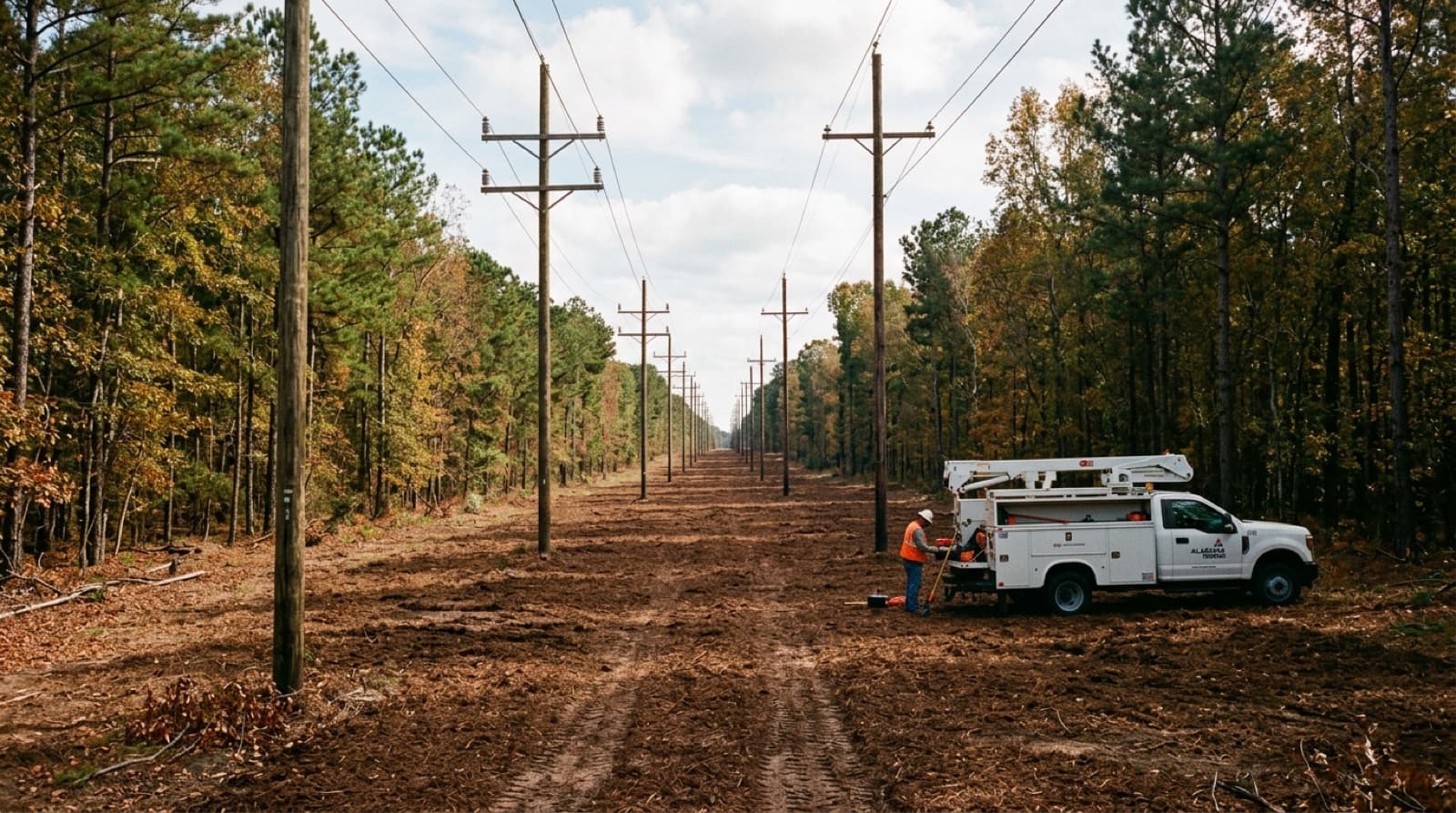
Right of Way Clearing in Huntsville, AL
An easement that's grown shut isn't access. It's a promise on paper. Driveways, utility corridors, and rights of way opened up and kept open, at a fixed written price.
Prefer to talk? (256) 973-8415Rocket City Land Clearing clears rights of way, easements, and access corridors across Huntsville and Madison, Limestone, and Morgan counties. That includes overgrown driveways and private roads, utility and drainage easements, road frontage, and deeded access routes, cleared by forestry mulching with a written fixed price before any equipment rolls.
Serving Huntsville, Madison, Athens, Decatur and all of North Alabama. · Updated August 2026
Access You Own on Paper vs. Access You Can Drive
A right of way is only worth what you can actually move through it. The deeded easement to your back parcel in Gurley doesn't help when it's a privet tunnel. The driveway to the home site you bought outside New Market doesn't exist yet if a truck can't make it in. The frontage on your commercial lot doesn't sell anything when passing traffic can't see the entrance.
North Alabama growth closes corridors fast. Brush crowds in from both sides, limbs drop the ceiling, and kudzu (a foot a day in summer) drapes over whatever holds still. A lane that fit a pickup two years ago now scrapes both mirrors, and the corridor problem compounds: the narrower it gets, the less it's used, and the less it's used, the faster it closes.
We reopen these corridors to full, usable width (floor, walls, and clearance height) and leave them in a condition you can maintain instead of re-fight. That's the difference between owning access and re-buying it every few years.
Utility Corridors, Easements, and Staying Off the Notice List
If a power, gas, water, or sewer easement crosses your land, keeping it passable isn't optional. Utilities have the right to access their lines, and vegetation that blocks a corridor tends to attract flagging, notices, and eventually someone else's crew clearing it on someone else's schedule. Clearing it on your terms means you decide what the corridor looks like when they're done, and what stays along its edges.
The same logic covers drainage easements that flood when brush chokes the flow line, shared private roads where every neighbor assumed someone else would deal with it, and deeded access strips that need to be demonstrably open before a parcel closes or a dispute settles.
Because forestry mulching grinds the growth in place, the corridor comes out clean instead of scarred: no burn piles inside an easement, no debris windrows pushed onto the neighboring parcel, no torn-up ground turning a drainage way into an erosion problem. The mulch layer holds the soil and slows the regrowth trying to close the corridor behind you.
- Utility easements: power, gas, water, and sewer corridors cleared and kept accessible
- Drainage easements and flow lines opened so water moves instead of backing up
- Deeded access easements proven open for closings, splits, and disputes
- Shared private roads and lanes reclaimed to full width
- Ground mulched in place: no burn piles, windrows, or erosion scars in the corridor
Driveways, Private Roads, and Road Frontage
For rural and residential owners, the right of way that matters most is the one to the front door. We clear new driveway corridors on raw land, the first pass that turns a flagged route into a lane a concrete or gravel crew can build on, and we reclaim existing drives that the woods have been narrowing for years: brush out of the shoulders, saplings out of the ditch line, clearance opened up for trucks, trailers, and delivery vans that currently refuse the trip.
For commercial and farm properties, frontage is the moneymaker. Brush along the road hides your entrance, your signage, and your sight lines, and sight distance at a driveway apron is a safety issue, not just a cosmetic one. Clearing the frontage puts the property back in view of every vehicle that passes it.
This is corridor work, and we price it like corridor work: by the run, not by a loose acreage guess. Most projects start within one to two weeks of an approved quote, and the crew (10+ years on North Alabama ground, the same team behind Huntsville Tree Service) walks the finished corridor with you before the machine leaves.
What Drives the Price of Right of Way Clearing
Corridor jobs vary too much for one honest flat rate, so here's what actually sets the number. Length is the base: a 300-foot driveway and a half-mile easement are different days. Width and clearance height come next: a walking corridor, a truck lane, and a full utility-spec corridor are three different amounts of grinding. Density does the rest: a lane that's merely brushy prices differently than one that's gone to privet trunks and kudzu canopy. Terrain and access round it out: slopes, wet ground, and corridors you can only enter from one end slow the machine down.
What you'll never get from us is an hourly meter or a quote that grows as the job does. We walk the corridor, you get a written fixed price before equipment rolls, and that number is the invoice. Travel is included for the first 25 miles, and the instant online estimate gives you a working number in about two minutes.
If the growth is light enough that brush hogging can handle stretches of it, we quote it that way. The method matches the corridor, not the other way around.
Right of Way Clearing Questions, Answered.
How much does right of way clearing cost in Huntsville, AL?
It's priced per job, because corridors vary: length, cleared width, clearance height, growth density, terrain, and access set the number. You get a written fixed price after a free walkthrough, before any equipment rolls, and travel is included for the first 25 miles. The instant online estimate gives you a working figure in about two minutes.
Can you clear an overgrown easement so I can reach a back parcel?
Yes. Reopening deeded access easements is core right of way work. We clear the corridor to a width and height that fits what you need to move through it, from a pickup to equipment. If the easement needs to be demonstrably open for a closing or a dispute, the cleared corridor and your written quote document exactly what was done.
Who is responsible for clearing a utility right of way on my property?
Utilities generally hold the right to access and clear their own corridors, but many landowners clear easements themselves to control how the work is done and what the corridor looks like afterward. If you've been flagged or noticed about vegetation in an easement, clearing it on your terms usually beats waiting for a contractor working to someone else's spec.
Can you cut in a new driveway corridor on raw land?
We do the clearing pass: brush, saplings, and small trees mulched out of the flagged route to a drivable width, leaving a corridor a grading or gravel crew can build on. For the follow-on dirt work, our driveway and access road clearing service under site preparation picks up where the mulcher stops.
How wide do you clear a right of way?
To whatever the corridor's job requires: a narrow lane for walking access, roughly a vehicle-and-shoulders width for driveways, or wider utility-spec corridors. Width and clearance height are the biggest price drivers after length, so we set both with you at the walkthrough and fix them in the written quote.
How long does right of way clearing take?
Most residential-scale corridor jobs finish in one to two days on site; long easements and heavy growth take longer, and your quote includes the timeline. Most projects start within one to two weeks of approval, and we walk the finished corridor with you before we call it complete.
Get your right of way clearing quote.
Tell us what you're working with. We'll walk the site, flag what stays, and hand you a written fixed price with a start window.
Or send the details now.
Two fields and a sentence is enough, we'll take it from there.